

JRace, a professional sports flooring and running track manufacturer, explains why, when constructing running tracks, basketball courts, tennis courts, or multi-purpose sports facilities, the installation method of the sports surface is just as important as the materials themselves.
At present, the main installation methods include in-situ, prefabricated, and semi-prefabricated systems, which combine characteristics of the two.
So, what is semi-prefabricated sports flooring? And how does it differ from traditional in-situ and prefabricated sports flooring?
It should first be noted that “semi-prefabricated” is not a standardized classification term universally adopted by international sports organizations. In overseas markets, it is more appropriate to use the term to describe a hybrid sports flooring system that combines factory-prefabricated materials with on-site installation.
What Is Semi-Prefabricated Sports Flooring?
Simply put, semi-prefabricated sports flooring means that part of the system is manufactured in a factory, while the remaining part is completed on site.
A typical structure uses a prefabricated layer manufactured in advance at the factory in the form of rolls, sheets, or cushioning layers. After being transported to the project site, the material is installed over a concrete or asphalt base, followed by the application of a polyurethane, acrylic, or other functional surface layer.
Therefore, semi-prefabricated does not mean that “only half of the sports court is prefabricated.” Instead, it refers to a combination of a “prefabricated layer + in-situ surface layer.”
What Is the Difference Between In-Situ, Semi-Prefabricated, and Prefabricated Sports Flooring?
The most straightforward difference between the three systems is how much of the production and installation work is completed in the factory and how much is completed on site.
In-Situ: Mainly Completed On Site
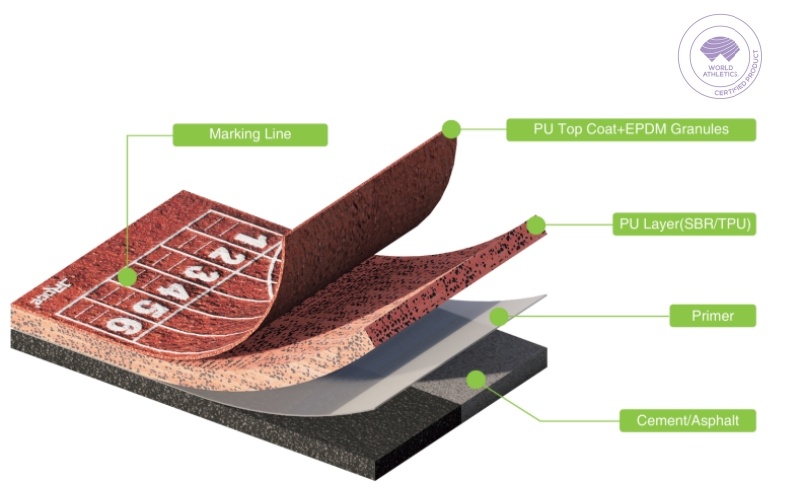
With an in-situ sports flooring system, most of the structural layers are installed on site. The installation team typically completes the base (Cement/Asphalt), elastic layer (PU Layer), top coat (Top Coat), and marking lines (Marking Line) as part of the construction process.
One advantage of this method is its strong adaptability to site conditions. The system can be adjusted according to the dimensions of the facility, condition of the base, and design requirements.
However, because there are more on-site construction processes, factors such as temperature, humidity, material mixing ratios, base flatness, and installation techniques can affect the final result.
Polyurethane sports surface systems, certain acrylic systems, and rubber granule-based systems may all be installed using in-situ construction methods.
Semi-Prefabricated: Factory Prefabrication + On-Site Installation
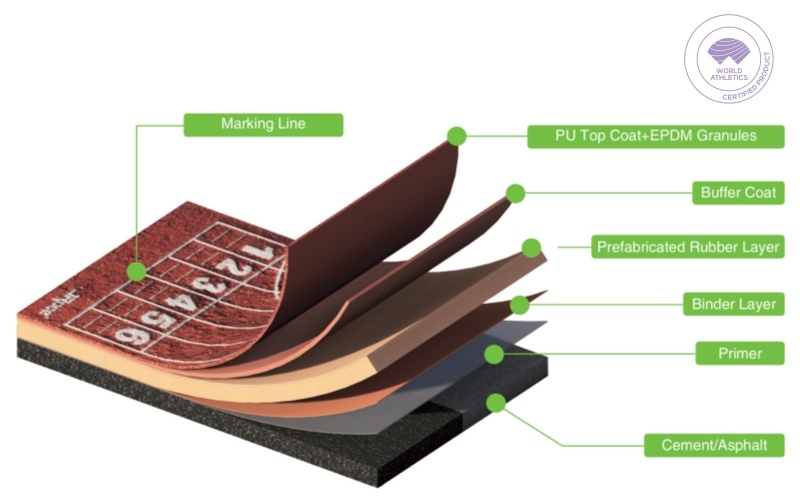
A semi-prefabricated system transfers part of the production process to the factory.
For example, a Semi-Prefabricated Cushioning Roller can be manufactured into rolls in advance. After the rolls are installed on site, a wear-resistant, anti-slip, or colored functional surface layer is applied.
One important purpose of this approach is to move structures that are suitable for standardized manufacturing into the factory, making thickness and material consistency easier to control, while retaining the flexibility of on-site surface application.
Therefore, a semi-prefabricated system can be considered a hybrid solution between in-situ and prefabricated sports flooring.
Prefabricated: More of the Structure Is Completed in the Factory
Prefabricated sports flooring has a higher degree of factory production.
The sports surface is generally manufactured into rolls at the factory and transported to the project site, where the main work involves installation and related procedures.
However, the flatness of the base, joints, and installation quality still need to be carefully controlled.
| System | Where the Work Happens | Key Points |
|---|---|---|
| In-Situ | Most structural layers installed on site: base, elastic layer, top coat, and marking lines | Strong adaptability to site conditions; final result sensitive to temperature, humidity, mixing ratios, base flatness, and installation technique |
| Semi-Prefabricated | Prefabricated layer (rolls, sheets, or cushioning) made in the factory; functional surface layer applied on site | Thickness and material consistency easier to control; keeps flexibility in color, texture, anti-slip performance, and facility-specific design |
| Prefabricated | Most of the structure manufactured into rolls in the factory; on-site work is mainly installation | Reduces on-site wet work; base flatness, joints, and installation quality still need careful control |
Why Is Semi-Prefabricated Sports Flooring Used?
The core value of a semi-prefabricated system is to balance the consistency of factory manufacturing with the flexibility of on-site installation.
With a completely in-situ system, factors such as material mixing, environmental conditions, and the skills and procedures of installers can affect the final result.
By manufacturing part of the structure in the factory in advance, certain aspects of the system can be produced under more controlled conditions. At the same time, applying the functional surface layer on site retains flexibility in terms of color, texture, anti-slip performance, and facility-specific design requirements.
Therefore, for facilities that need to combine standardized manufacturing with project-specific customization, a semi-prefabricated system provides another technical option.
How Should You Choose Between In-Situ, Semi-Prefabricated, and Prefabricated Sports Flooring?
When selecting a sports flooring system, it is not recommended to simply compare which installation method is “more advanced.” The more important consideration is how each system fits the actual project conditions.
Is the facility indoors or outdoors? Is it intended for a running track, basketball court, tennis court, or multi-purpose sports facility? Is the local climate hot, rainy, or subject to significant temperature changes? Is the base concrete or asphalt? How frequently will the facility be used? Are professional competitions or specific certification requirements involved?
These factors can be more important than the degree of prefabrication itself.
For outdoor courts and running tracks in particular, factors such as base stability, drainage, UV exposure, temperature changes, and long-term maintenance also need to be considered.
Ultimately, a high-quality sports facility is the result of the combined performance of materials, structural design, base, installation quality, and sports performance.
| Factor | What to Consider |
|---|---|
| Facility and Use | Indoors or outdoors; running track, basketball court, tennis court, or multi-purpose sports facility |
| Climate | Hot, rainy, or subject to significant temperature changes |
| Base | Concrete or asphalt; base stability and drainage, especially outdoors |
| Usage Frequency | How frequently the facility will be used |
| Competition and Certification | Professional competitions or specific certification requirements involved |
| Outdoor Durability | UV exposure, temperature changes, and long-term maintenance |
Semi-Prefabricated Flooring in Practice: The JRace SPUR Series
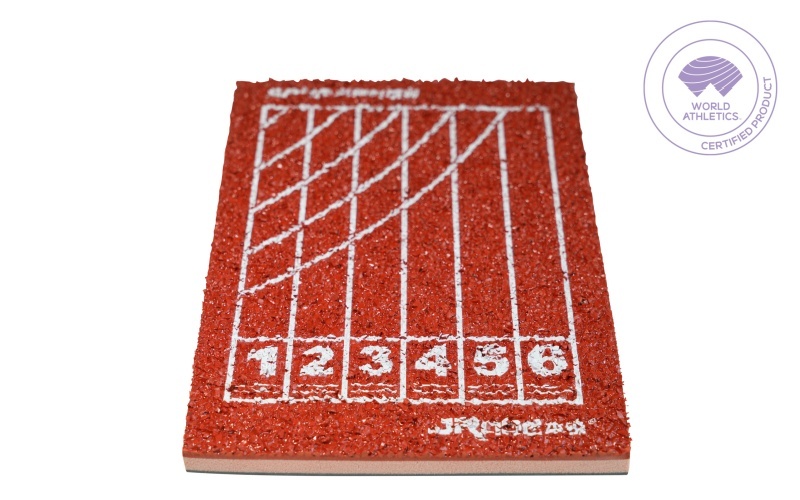
The JRace SPUR Semi-Prefabricated series combines a Semi-Prefabricated Cushioning Roller with an in-situ surface layer. It combines the uniform performance of prefabricated materials with the seamless and durable characteristics of in-situ surfaces, creating a system where 1 + 1 > 2.
The prefabricated roll has uniform thickness and stable performance, while the in-situ surface provides a seamless appearance as well as excellent wear resistance and weather resistance.
For running tracks, the system offers easy installation and allows straight laying on curves, helping to solve the arching problem commonly associated with traditional prefabricated tracks.
The Semi-Prefabricated Cushioning Roller uses high-density polyurethane material, which is spike-resistant and stretch-resistant, providing effective cushioning and protection.
The SPUR semi-prefabricated cushioning layer has a polymer content ≥80%, making it suitable for high-level running tracks and sports courts.
The ET Surface Technology is Tough & Impact-Resistant with Superior Fade Resistance, Excellent Abrasion/Weather Resistance & Wet Friction Performance, making it suitable for high-performance sports courts.
Frequently Asked Questions
Is “Semi-Prefabricated” a standardized international classification for sports flooring?
Not strictly. It is not a universally standardized international classification. Different manufacturers and markets may use different terminology.
For international projects, it is recommended to describe the specific flooring structure in addition to using the term “semi-prefabricated.”
What is the biggest difference between semi-prefabricated and prefabricated sports flooring?
A semi-prefabricated system typically has only part of its structure manufactured in the factory, while the surface layer is still installed on site.
With a prefabricated system, more of the structure has already been manufactured in the factory, and the main work on site is installation.
Is semi-prefabricated sports flooring always better than in-situ flooring?
Not necessarily.
In-situ, semi-prefabricated, and prefabricated systems each have their own suitable applications. The choice should be based on factors such as climate, base conditions, budget, construction schedule, and performance requirements.
What types of sports facilities can semi-prefabricated flooring be used for?
Depending on the specific product system, semi-prefabricated flooring can be used for basketball courts, tennis courts, multi-purpose sports facilities, and other synthetic sports surfaces.
For professional projects, it is also necessary to confirm whether the system meets applicable local regulations and the requirements of relevant sports organizations.
Is prefabricated sports flooring always faster to install?
Prefabricated systems can generally reduce on-site wet work. However, the overall construction schedule is still affected by base preparation, facility size, installation method, and site conditions.
What should be considered most when selecting sports flooring for an international project?
First, determine the type of sport and intended application. Then consider the climate, base, drainage, maintenance costs, and required sports performance.
For competition and certified facilities, the relevant technical requirements of the applicable international sports organizations should also be checked.
JRace specializes in the R&D and manufacturing of synthetic running tracks, sports courts, and professional sports flooring materials. We provide a range of sports surface solutions, including Spray Coat Running Track, Full PU Running Track, Full PU Mixed Type Running Track, Sandwich Running Track, Semi-prefabricated Running Track, and Prefabricated Rubber Track, together with professional technical support and installation guidance, helping clients create safe, durable, and high-performance sports facilities.
>