

When planning a basketball court project, choosing the right flooring material is an important decision. Different types of basketball court flooring can vary significantly in terms of playing experience, environmental suitability, maintenance requirements, and long-term performance.
Traditional wooden basketball flooring has long been regarded as a standard choice for professional basketball facilities, particularly in indoor competition venues and training centers. Meanwhile, with the growing development of outdoor sports facilities, school sports facilities, and community sports spaces, Silicon PU basketball courts have become an important solution for outdoor basketball facilities thanks to their good weather resistance, comfortable playing performance, and relatively low maintenance requirements.
So, what are the actual differences between Silicon PU basketball courts and traditional wooden basketball courts? Which option is more suitable for your project?
Application Environment: Indoor Wooden Flooring vs. Outdoor Silicon PU
One of the biggest differences between Silicon PU basketball courts and wooden basketball courts is their suitability for different environments.
Traditional wooden basketball flooring is primarily used in indoor sports facilities, such as professional basketball arenas, university gymnasiums, and indoor training centers. Since wood is a natural material, its performance can be affected by environmental conditions, making temperature, humidity, and facility conditions important considerations.
If exposed to excessive humidity for extended periods, wooden flooring may experience swelling or deformation. Continuous UV exposure, seasonal temperature fluctuations, and wear caused by frequent use can also affect the stability and service life of wooden flooring. Therefore, wooden basketball courts are generally installed in indoor spaces with good environmental control and require regular maintenance to maintain optimal playing performance.
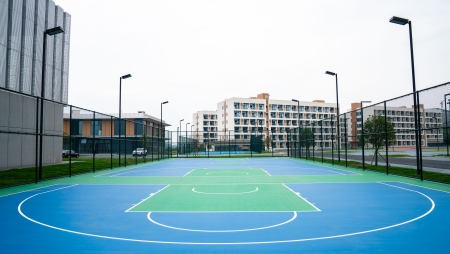
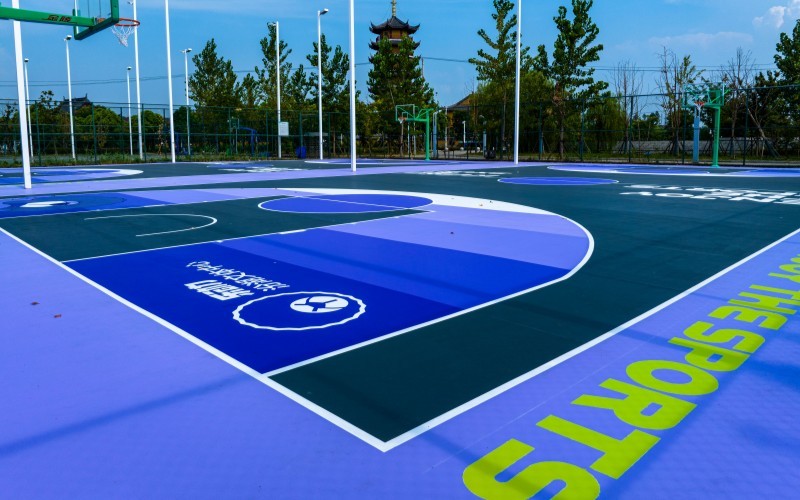
By comparison, Silicon PU basketball courts are designed for both indoor and outdoor sports environments and are widely used for school basketball courts, community sports facilities, sports parks, and multi-purpose sports areas. Silicon PU offers good weather resistance and can withstand sunlight, rain, and temperature fluctuations, making it highly adaptable to different environments.
Differences in Material Structure and Playing Performance
High-quality wooden flooring can provide excellent ball rebound and athletic feedback, which is why it is widely used in professional indoor basketball venues.
However, the playing performance of wooden flooring depends heavily on the overall structural design and installation quality, as well as proper environmental maintenance.
Silicon PU basketball courts use polyurethane-based synthetic materials and achieve a balance between comfort and durability through a multi-layer flooring structure.
This structure can provide good resilience and comfort while offering stable slip resistance and wear resistance, making it suitable for daily training, school sports programs, and public basketball courts.
Differences in Weather Resistance and Long-term Durability
For outdoor basketball courts, weather resistance is an important factor affecting service life.
Although wooden basketball flooring provides an excellent playing experience, it is not designed for long-term exposure to outdoor environments. Rain, moisture, direct sunlight, and temperature fluctuations can all increase the maintenance requirements of wooden flooring. Therefore, outdoor use of wooden flooring generally requires additional protective measures; otherwise, environmental exposure may negatively affect court performance.
Silicon PU basketball courts, on the other hand, are optimized for outdoor environments. Their material structure can effectively withstand UV exposure while providing good water resistance and resistance to temperature fluctuations. During long-term outdoor use, Silicon PU can maintain relatively stable surface performance and reduce damage caused by environmental factors.
For schools, communities, and public sports facilities, weather resistance is often one of the key factors when selecting sports flooring.
Differences in Playing Comfort and Safety
Basketball involves extensive running, jumping, and rapid changes of direction, making shock absorption an important flooring performance characteristic.
Professional wooden basketball courts typically use a combination of a wooden surface layer and an elastic support system to provide cushioning and deliver a comfortable playing experience.
Silicon PU basketball courts use elastic layers to help reduce impact forces generated during physical activity, providing a more comfortable underfoot feel during running and jumping. For students, recreational players, and people who train regularly, good shock absorption can improve comfort and help reduce the impact experienced during sports activities.
In addition, the slip resistance of Silicon PU surfaces can help players maintain stability during rapid movements and changes of direction.
Differences in Maintenance Requirements
Although wooden basketball flooring offers a professional appearance and premium visual appeal, it generally requires more maintenance.
Because the wood needs to be kept in good condition, venues typically require regular cleaning, maintenance, and surface refinishing. Indoor environmental conditions also need to be controlled to prevent changes in humidity from affecting the flooring.
By comparison, Silicon PU basketball courts are easier to maintain. During normal use, routine surface cleaning and regular inspections are generally sufficient. If localized damage occurs, targeted repairs can be carried out on the affected area.
For schools, communities, and public sports facilities that remain open for extended periods, lower maintenance requirements can help reduce operating costs.
Differences in Installation Requirements
Wooden basketball flooring generally requires a more stable indoor environment during installation. Since wood is affected by changes in temperature and humidity, environmental conditions need to be controlled during installation. Professional installation techniques are also required to reduce the risk of deformation, cracking, or joint changes after installation.
Silicon PU basketball courts offer greater installation flexibility. They can be installed over properly prepared concrete or asphalt substrates and are suitable for various types of outdoor sports projects.
However, regardless of the flooring material selected, substrate preparation is an important factor affecting the final result. A high-quality basketball court depends not only on the flooring material itself but also on the installation team's expertise in substrate preparation, material application, and detail control.
Differences in Appearance and Application Scenarios
Wooden basketball flooring has a classic appearance created by natural wood and can create a professional competition atmosphere, making it particularly suitable for indoor competitive basketball facilities.
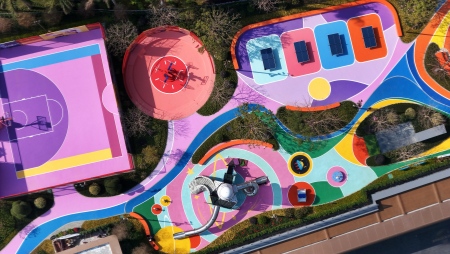
Silicon PU basketball courts offer greater design flexibility. Customers can choose different color combinations according to project requirements and incorporate school logos, brand elements, or court layouts into customized designs.
For schools, communities, and public sports facilities, a wider range of color options can enhance the visual appeal of sports spaces while meeting the design requirements of different projects.
Silicon PU Basketball Court vs. Wooden Basketball Court: Comparison
| Comparison Item | Silicon PU Basketball Court | Wooden Basketball Court |
|---|---|---|
| Primary Applications | Outdoor basketball courts, multi-purpose sports facilities | Indoor professional basketball arenas |
| Environmental Adaptability | Suitable for sunlight, rain, and temperature fluctuations | Requires greater environmental control |
| Water Resistance | Excellent | Relatively low |
| Maintenance Requirements | Simple routine maintenance | Requires regular maintenance |
| Typical Applications | Schools, communities, sports parks, public sports facilities | Professional competition venues, indoor training centers |
| Design Options | Wide range of colors and customizable designs | Primarily natural wood appearance |
| Long-term Operating Costs | Relatively low | Relatively high |
Which Basketball Court Flooring Is Right for Your Project?
There is no absolute winner between Silicon PU basketball courts and wooden basketball courts. Each flooring system is designed for different types of projects.
If your project is a professional indoor basketball competition venue or you are looking to create a high-level competitive environment, wooden flooring remains a classic choice. It can provide a professional playing experience while creating the traditional atmosphere associated with basketball arenas.
However, if your project involves an outdoor basketball court, school sports facility, community sports space, or public multi-purpose sports area, Silicon PU basketball flooring is often a more practical solution.
It offers a better balance between playing performance, durability, maintenance requirements, and environmental adaptability, making it well suited to the long-term needs of most outdoor basketball court projects.
JRace Sports' innovative JRace FIBA-certified court flooring was specifically developed for multi-purpose sports facilities. It is the first Silicon PU basketball court product in China to receive FIBA certification for both indoor and outdoor applications.
Its performance is comparable to professional wooden flooring, with key indicators such as shock absorption and ball rebound meeting FIBA requirements. It features Buffer Coat Polymer Content 80%, combined with a high-performance ET surface layer that delivers excellent performance in both dry and wet friction tests.
Whether used indoors or outdoors, it can accommodate a variety of sports, including basketball, badminton, and volleyball, providing a multi-purpose sports flooring solution that combines professional performance, comfort, and durability.
Conclusion
Silicon PU basketball courts and wooden basketball courts represent two different approaches to sports flooring.
Wooden basketball flooring is more suitable for indoor environments where professional competition performance is the priority, while Silicon PU basketball flooring is better suited to sports projects that require weather resistance, low maintenance, and long-term outdoor use.
For schools, communities, and public sports facilities, selecting the right basketball court flooring requires more than considering the initial investment. Local climate conditions, usage frequency, and long-term maintenance costs should all be taken into account.
By selecting the appropriate sports flooring system, project owners can create basketball spaces that are safer, more durable, and more comfortable for users.
As a professional sports flooring supplier, JRace Sports offers a range of Silicon PU solutions, including SPUR Semi-prefabricated Sports Court, Two-component Sports Court, PU Unite-Tech Sports Court, and SPU Shock-absorbing Sports Court, providing options for a wide variety of professional and recreational sports applications.
With more than a decade of market experience, JRace Sports' multiple products have been installed in sports facilities across different regions worldwide, providing customers with reliable sports flooring solutions for a variety of project requirements.