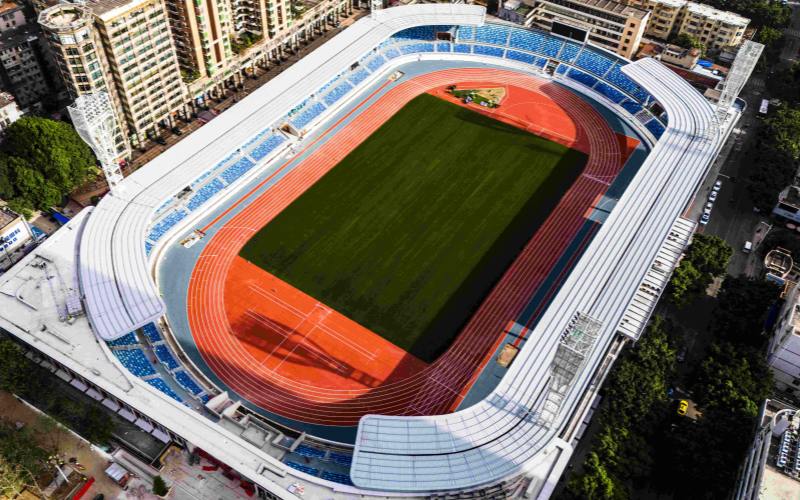


When you step onto a rubber running track, you may notice that it feels completely different from ordinary concrete flooring. It does not feel excessively hard, but neither does it sink noticeably like a thick rubber mat.
This “balanced” feel is not accidental.
When evaluating the performance of a rubber running track, two frequently mentioned indicators are Shock Absorption and Vertical Deformation. Although the terms may sound technical, they are not difficult to understand.
Simply put, one indicates how much impact the track can absorb, while the other indicates how much the track deforms when subjected to load.
1. What Is Shock Absorption?
Every foot strike during running generates impact. Hard surfaces such as concrete and ceramic tiles provide very little elastic cushioning, while rubber running tracks have a certain degree of elasticity and can absorb part of the impact generated when the foot lands.
This ability is known as Shock Absorption.
It can be compared to the shock absorption system of a car.
Without a shock absorption system, most of the vibration generated when driving over an uneven road would be transferred directly to the vehicle body. With a shock absorption system, part of the impact is absorbed.
Although the elastic structure of a rubber running track is completely different from a vehicle suspension system, the analogy can help explain the basic concept: the track provides a cushioning layer between the runner’s foot and the hard base.
This is also why a professional running track is not simply a layer of colored material applied over concrete or asphalt. It requires a sports surface with an appropriate thickness and degree of elasticity.
The dynamic interaction between the athlete and the track can affect both athletic performance and safety. Therefore, the track’s ability to reduce impact and absorb energy is important.
The technical requirements for athletics surfaces specify an appropriate range for shock absorption rather than simply requiring the highest possible value.
2. Is Higher Shock Absorption Always Better?
No.
This is a common misunderstanding about rubber running tracks: if cushioning reduces impact, does that mean a softer track is always more comfortable?
Not necessarily.
Imagine running on a beach. Sand is very soft, and the impact may feel less noticeable than on concrete. However, your feet sink into the sand with every step, requiring more effort to move forward.
At the other extreme, running directly on an extremely hard surface results in more direct impact when the foot lands.
A running track needs to find a balance between these two extremes.
| Feel | Example in the article | Problem |
|---|---|---|
| Too soft | Running on a beach | Feet sink with every step, requiring more effort to move forward; excessive deformation can mean greater energy loss and reduced stability |
| Too hard | Running directly on concrete | More direct impact when the foot lands; very little deformation may indicate that the surface is excessively hard |
| Balanced | A good sports running track | Appropriate cushioning with sufficient stability; not as hard as concrete, and not so soft that the surface noticeably sinks with every step |
Therefore, a good sports running track does not simply aim to be “as soft as possible.” Instead, it aims to achieve an appropriate balance between cushioning, stability, and athletic performance.
3. What Is Vertical Deformation?
If Shock Absorption focuses on “how much impact is absorbed,” Vertical Deformation focuses on:
“How much does the track deform downward when an athlete steps on it?”
For example, when you press a sponge with your hand, it sinks downward and returns to its original shape after you release it.
A rubber running track also undergoes a similar type of small deformation when subjected to foot impact. However, the deformation is usually only a few millimeters and is difficult to observe with the naked eye.
4. What Is the Difference Between Shock Absorption and Vertical Deformation?
These two indicators are often discussed together, but they are not the same thing.
| Indicator | What it looks at | What it mainly reflects |
|---|---|---|
| Shock Absorption | How much impact is absorbed | The surface system’s ability to reduce impact |
| Vertical Deformation | How much the surface deforms under load | The degree of deformation produced when the running track is subjected to load |
Together, these factors influence how the track feels in terms of softness and firmness.
Therefore, simply saying that a running track has “good elasticity” is not sufficiently precise. A sports surface needs to be evaluated based on how the complete system responds dynamically to the forces generated by athletes.
5. Why Do Different Rubber Running Tracks Feel Different?
If you have visited different athletics tracks, you may have noticed that some surfaces feel noticeably softer, while others feel firmer and more stable.
This is because the feel of a running track is not determined by a single material. The final performance can be affected by:
| Factor | Examples given in the article |
|---|---|
| Track system structure | Prefabricated system, full PU system, or another structure |
| Elastic layer | Material and thickness of the elastic layer |
| Base underneath | Type of base underneath the track |
6. What Are the Advantages of Jrace Sport Products in Terms of Shock Absorption and Vertical Deformation?
Both products below have been tested for Shock Absorption and Vertical Deformation, and show a balanced profile: enough cushioning to reduce impact, without excessive deformation that would reduce stability or increase energy loss.
| Product | Performance in tests |
|---|---|
| SPUR semi-prefabricated running track | Balanced softness and firmness in Shock Absorption and Vertical Deformation tests; good physical performance |
| Uni-tech solvent-free full PU running track | Balanced softness and firmness in Shock Absorption and Vertical Deformation tests; good physical performance |
They are suitable for a wide range of sports facilities.
About the test data: Current test reports are based on China’s mandatory national standard. For projects outside China, the measured values can be used as a reference and checked against the standard applicable in the project location.
7. A Running Track Is Not Better Simply Because It Is Softer
When purchasing rubber running track materials, you may hear descriptions such as “high elasticity,” “ultra-soft,” or “excellent cushioning.”
However, for a professional sports surface, simply emphasizing softness does not mean much.
A running track is first and foremost a sports surface.
It needs to provide an appropriate level of cushioning while maintaining sufficient stability. It should not be as hard as concrete, but neither should it be so soft that the surface noticeably sinks with every step.
Therefore, when evaluating whether a running track is comfortable or suitable for sports, it is not enough to simply press it with your hand or step on it.
The following should all be considered together:
Shock Absorption
Vertical Deformation
Friction performance
Thickness
Overall structure of the running track system
From this perspective, the “elasticity” of a rubber running track is not simply about softness. It is a carefully designed balance between softness and firmness.
FAQ: Frequently Asked Questions About Running Track Elasticity
Q1: Is a higher Shock Absorption value always better?
No.
An excessively low value may make the track feel too hard, while an excessively high value does not necessarily make it more suitable for running.
A sports running track needs to achieve a balance between cushioning, stability, and athletic performance.
Q2: Does greater Vertical Deformation mean that the running track has better elasticity?
Not necessarily.
Excessive Vertical Deformation means that the track deforms more when the foot lands, which may result in greater energy loss and reduced stability. On the other hand, very little deformation may indicate that the surface is excessively hard.
Q3: Do ordinary school running tracks also need to consider these two indicators?
Yes, they are worth considering.
Even if a running track is not intended for professional competition, Shock Absorption and Vertical Deformation can still help evaluate the cushioning and deformation characteristics of the sports surface.
However, the specific requirements should be determined according to the applicable standards and intended use of the project location.