

Full PU Running Tracks are formed on site, while Prefabricated Running Tracks are factory-made and then installed on site. Both can provide good performance, depending on formulation, structure, thickness, and installation quality. Choose Full PU for on-site adaptability, Prefabricated for factory consistency and standardized installation, and for competition venues, verify certification requirements.
1. Different Installation Methods
A Full PU Running Track is a type of cast-in-place running track that is installed and formed on site.
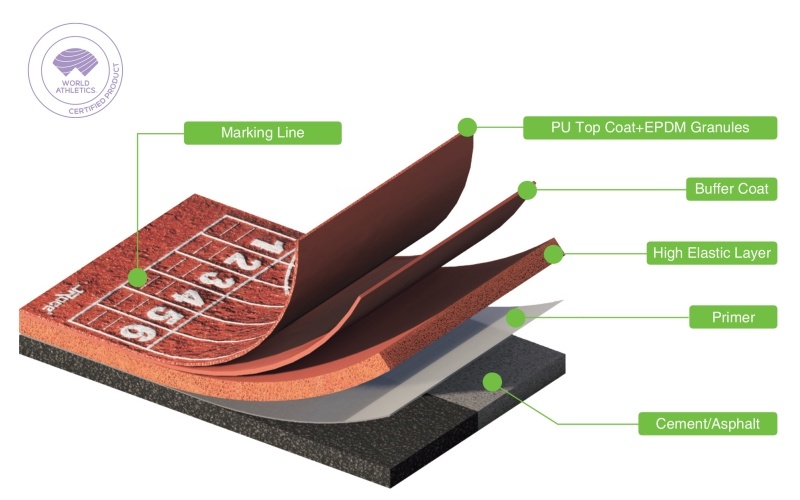
A Prefabricated Running Track, on the other hand, is manufactured and formed in a factory before being transported to the project site for installation. Since most of the production process is completed under controlled factory conditions, on-site work mainly involves track installation and joint treatment.
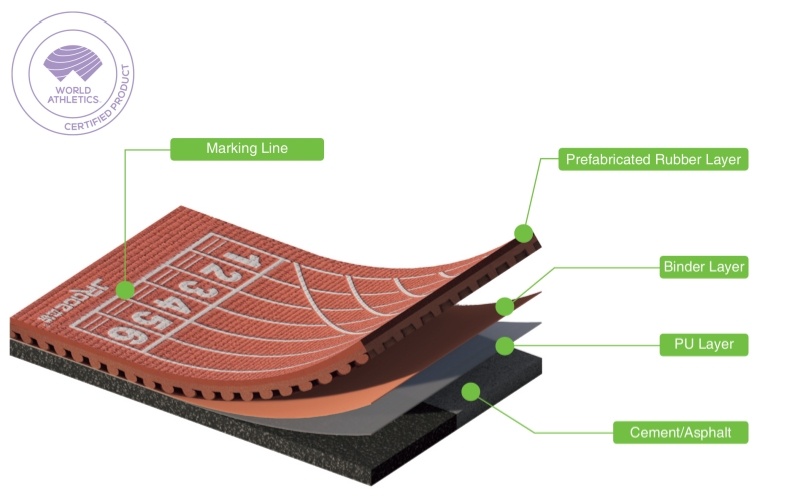
Therefore, the most straightforward difference is: Full PU Running Tracks are formed on site, while Prefabricated Running Tracks are factory-manufactured and then installed on site.
2. How Do Their Athletic Performance Characteristics Differ?
Track performance is one of the key concerns for buyers. Important factors include elasticity, shock absorption, energy return, underfoot feel, and stability during use.
Both Full PU and Prefabricated Running Tracks can be designed to provide good athletic performance. Their actual performance depends on factors such as the product formulation, system structure, thickness, and installation quality, rather than simply whether the track is Full PU or Prefabricated.
Because Prefabricated Running Tracks are primarily manufactured in a factory, product consistency can generally be controlled more systematically. Full PU Running Tracks, meanwhile, can be designed according to the specific project requirements and corresponding installation conditions.
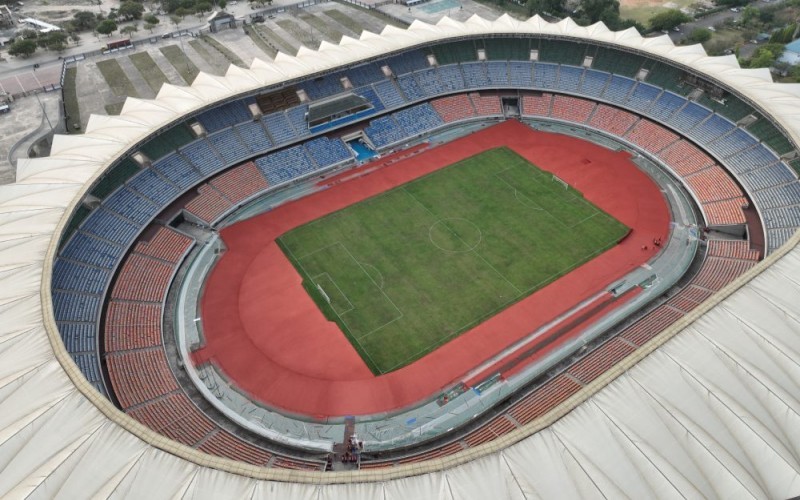
In 2024, JRace Sports constructed a Full PU Running Track at the National Stadium in Tanzania, designed to meet the requirements of high-level international competitions. The project is a competition-grade Full PU Running Track designed for World Athletics Class 1 certification.
| Aspect | Full PU Running Track | Prefabricated Running Track |
|---|---|---|
| Installation | Cast-in-place, installed and formed on site. | Manufactured and formed in a factory, then transported to the project site for installation. |
| On-site work | Installation and forming. | Mainly installation and joint treatment. |
| Performance consistency | Can be designed according to the specific project requirements and corresponding installation conditions. | Consistency can generally be controlled more systematically, as most production is completed under controlled factory conditions. |
3. What About Durability and Maintenance?
The service life of a running track is not determined by the track type alone.
Whether Full PU or Prefabricated, a running track can be affected over time by factors such as usage frequency, weather conditions, UV exposure, cleaning and maintenance practices, and installation quality.
Therefore, when comparing the two systems, buyers should not focus only on the product type. It is also important to consider material quality, system structure, installation standards, and long-term maintenance requirements.
More Concerned About Durability? Consider JRace Sports' Prefabricated Running Track
JRace Sports' Prefabricated Running Track features a refined two-layer structure. The specially designed bottom structure and manufacturing process help achieve strong bonding with the polyurethane adhesive, while providing good shock absorption and vertical deformation performance. The surface layer provides spike resistance, weather resistance, aging resistance, and slip resistance.
It uses a 15-year Special Rubber Formula designed for long-term durability, with super strong UV resistance, strong and stable bonding, and competition-grade physical performance.
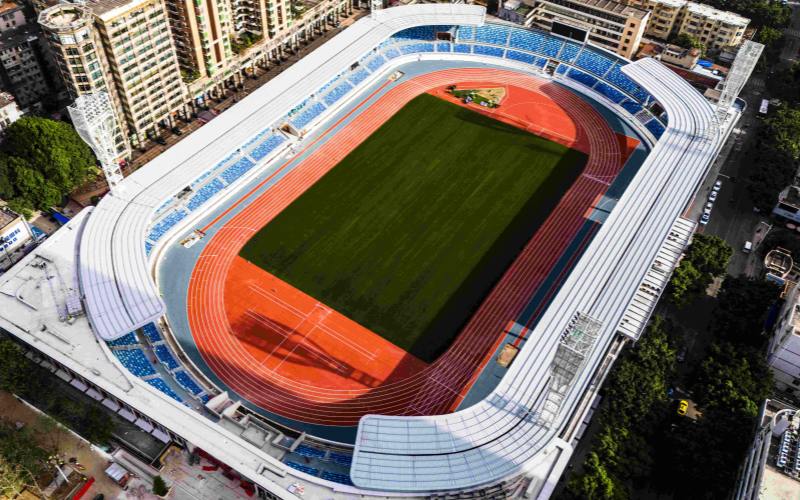
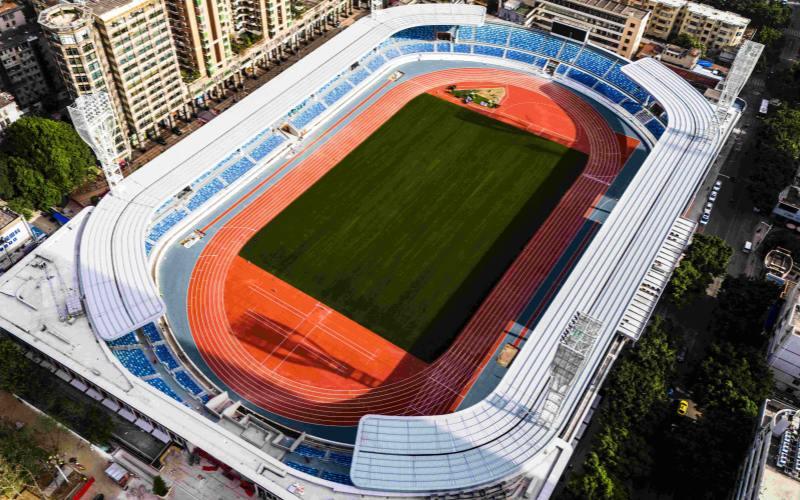
JRace Sports has provided professional prefabricated running track solutions for projects in multiple countries. The Guangdong Provincial Gymnasium, the main venue for China's National Games, also uses a JRace Sports Prefabricated Running Track.
| Layer | What it provides |
|---|---|
| Bottom layer | Specially designed structure and manufacturing process, strong bonding with the polyurethane adhesive, and good shock absorption and vertical deformation performance. |
| Surface layer | Spike resistance, weather resistance, aging resistance, and slip resistance. |
4. How Should You Choose?
If a project places greater emphasis on on-site installation adaptability, system design, and the overall installation method, a Full PU Running Track may be considered.
If the project places greater emphasis on factory manufacturing, product consistency, and standardized installation, a Prefabricated Running Track is also worth considering.
For schools and general sports facilities, the decision should focus on actual usage requirements, budget, site conditions, and maintenance needs. For professional competition venues, buyers should also verify whether the selected running track system meets the relevant certification and project requirements.
| Project focus | How to decide |
|---|---|
| On-site installation adaptability, system design, and overall installation method | Consider a Full PU Running Track. |
| Factory manufacturing, product consistency, and standardized installation | Consider a Prefabricated Running Track. |
| Schools and general sports facilities | Focus on actual usage requirements, budget, site conditions, and maintenance needs. |
| Professional competition venues | Also verify whether the selected system meets the relevant certification and project requirements. |
Conclusion
There is no simple answer as to whether Full PU or Prefabricated Running Tracks offer better overall performance.
Full PU Running Tracks emphasize forming a complete track system through on-site installation, while Prefabricated Running Tracks emphasize factory manufacturing and standardized on-site installation. Both systems can provide good athletic performance. The final choice should be based on a comprehensive evaluation of elasticity and underfoot feel, durability, installation conditions, budget, and certification requirements.